

Notes from GITEX Ai Türkiye 2026
GITEX arrived in Istanbul this week for its first Türkiye edition. Notes from two days at the Istanbul Expo Center, and why this country is becoming a serious place to build AI software.
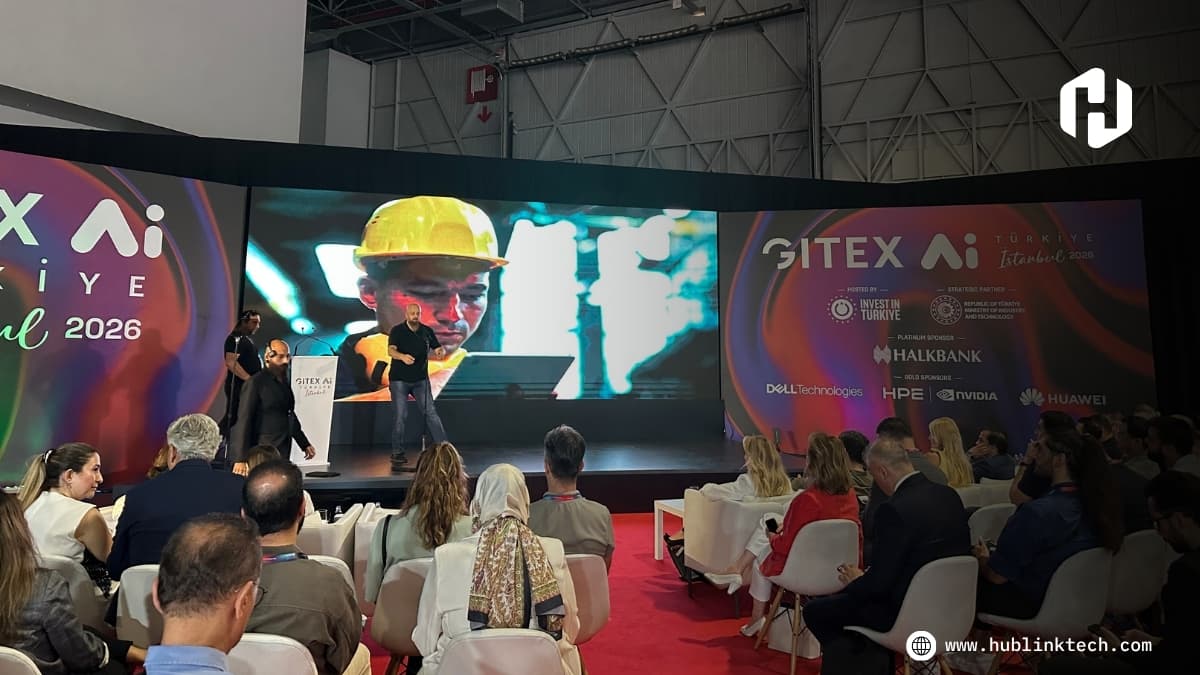
GITEX held its first Türkiye edition this week, on 9 and 10 September at the Istanbul Expo Center. We attended both days. These are notes on what was on the floor and what it indicates about building an AI software company from this country.
What the event actually was
GITEX Ai Türkiye was hosted by the Investment and Finance Office of the Presidency of the Republic of Türkiye, in strategic partnership with the Ministry of Industry and Technology, and organised by inD, the organiser behind GITEX globally.
The published figures: over 350 enterprise and startup exhibitors, around 100 speakers, and roughly 150 investors with more than $75 billion in assets under management, with attendance drawn from about 70 countries. Global technology companies including Google Cloud, HPE, NVIDIA, AWS, Huawei, Dell Technologies and SAP exhibited alongside Turkish organisations including Trendyol and Halkbank, and technoparks including İTÜ ARI Teknokent and Antalya Teknokent.
For a first edition, that is a substantial floor. More relevant than the scale is who convened it. This was a state-hosted event with ministerial participation, not a commercial expo that happened to be held in Istanbul.
Why this matters for a software company operating here
Three observations, in order of how much they affect an engineering business.
Infrastructure is being committed, not discussed. The event coincided with Türkiye's 2026–2030 AI Action Plan, which targets 1GW of data centre capacity, the mobilisation of $10 billion in private sector investment for AI infrastructure, and AI training for five million citizens over the next two years.
Data centre capacity is the least glamorous item on that list and the most consequential for anyone running production AI systems. Inference has to happen somewhere. Where it happens determines latency, cost and, increasingly, which jurisdictions will accept your data handling. Domestic capacity changes the arithmetic for every AI product built here.
The talent argument is credible. Turkish engineering output is strong and comparatively young. That has been true for some time. What was different at this event was that the argument was being made to international investors in the room, rather than asserted domestically. The country's ICT market is now valued at around $38 billion.
Istanbul positions itself as a corridor, not a market. This was the recurring framing across the event — Türkiye as a Eurasian digital corridor rather than as a single national market.
That framing is correct, and it is the reason we build what we build.
The corridor thesis
A company operating from Istanbul sits between markets that most software is not built for.
Western platforms are built primarily for lanes into Western Europe and North America. Their regulatory depth follows their customer base, which means the trade routes running between Türkiye, Iran, the Caucasus and Central Asia are covered thinly or not at all. The businesses moving goods along those routes are not small in aggregate. They are simply not the market anyone optimised for.
This is a structural opportunity rather than a sentimental one. Regulatory depth does not generalise. Each jurisdiction publishes its rules differently, updates them on its own rhythm, and carries its own structural quirks. Covering a market properly is work that has to be done per market, which means incumbents cannot extend into this corridor cheaply. They would have to do the same work, and their customers are not asking them to.
Our platforms are built on that reading.
Hublinkly is an AI-powered B2B trade network — verification, matching, RFQ handling, multilingual trade advice, route risk and live market data in one system. It is live at hublinkly.com.
Clavix360 is an AI CRM and ERP covering HR, sales, marketing and finance over a single record set, with five industry engines for sectors including real estate, construction, clinics and trading teams. It is live at clavix360.app.
Ara is a trade intelligence agent, currently in development, answering HS classification, tariff, documentation and route risk questions from live regulatory data. It is being built for this corridor first. Narrow and deep before wide and shallow.
What we took from two days
Events like this are useful as a temperature reading, not as a source of business. The reading was clear enough.
The infrastructure commitments are specific and dated, which is the difference between a policy and an announcement. The international attendance was real. And the corridor framing that shaped our product decisions was, at this event, the official framing of the country's technology strategy.
We build from Istanbul because the position is genuinely advantageous, not because we happen to be here. This week made that case in public, at scale, and to an audience that had flown in to assess it.
Sources
- GITEX Ai Türkiye event details and figures, IoT Now, 10 September 2026
- GITEX Ai Türkiye participation and hosting structure, CXO Insight Middle East, 10 September 2026
- Türkiye ICT market value and exhibitor list, Yeni Şafak, August 2026